
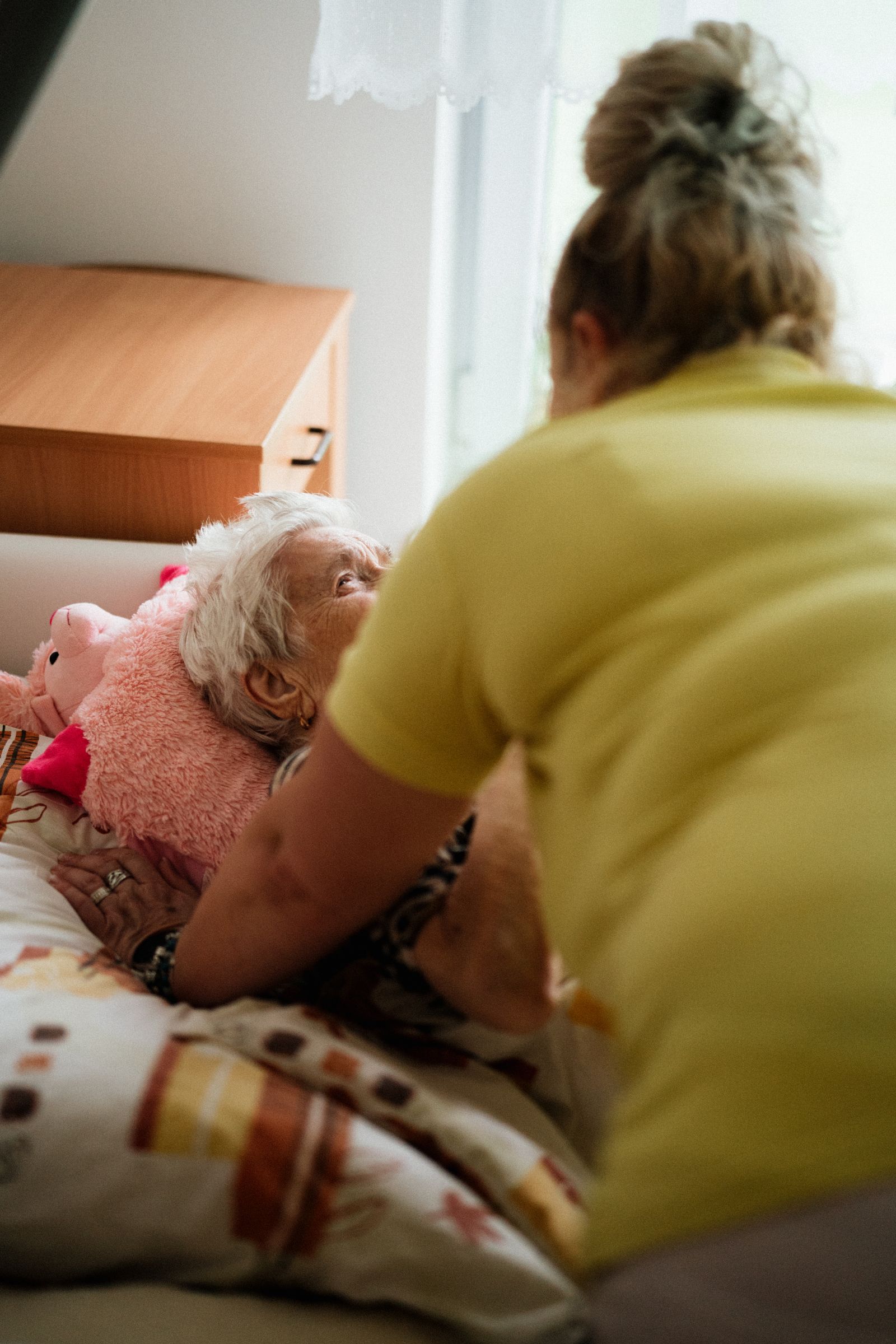
Dementia and Alzheimer's care at home.
Care rooted in patience and dignity. Structured routine, gentle redirection, and memory-supportive company that lowers the confusion of a hard day and keeps your loved one themselves for longer.
- Licensed in TexasHCSSA #023843
- How we workPrivate pay, non-medical
- When you callA real person, never a call center
Dementia does not announce itself. It arrives in small moments. A forgotten name. A key that no longer works in a way no one can explain. A wrong turn on a street driven for forty years. Slowly it asks more of the day, and more of the family. We do not meet that with a checklist. We meet it with a steady presence: a predictable rhythm, gentle redirection instead of correction, and the assumption that the person in front of us is, and will always be, a person first.
Continuity is the difference between a stranger and a steady presence.
No vague reassurance. Here is exactly what a caregiver does in this home, on an ordinary day, kept to the plan and documented.
Memory-supportive company
Familiar conversation, old music, the photographs and rituals that anchor a sense of self. Engagement tuned to the day they are actually having, not the one a plan predicted.
A routine that holds
A predictable shape to meals, rest, activity, and the hard transitions between them. Predictability is not a luxury here. It is what lowers the anxiety underneath the confusion.
Personal care with dignity
Bathing, dressing, grooming, done with patience and privacy. The work that is easiest to rush is the work we refuse to rush.
Steady through sundowning
When the late-afternoon light shifts and agitation rises, we do not argue or push back. We steady the room, redirect gently, and bring the moment down.
Honest family communication
Visit notes when they help, a call when something genuinely needs your attention, and a real person on our care team who knows your family to reach when you want to talk. Never a call center.
The need changes as the season does. The plan changes with it, and the team does not. Here is how an engagement is built to move.
- Early stage
The diagnosis is recent and independence is mostly intact. They are still themselves for long stretches. The disease shows in small ways: the repeated story, the missed appointment, the key that stopped working. The work here is light, a few hours a few days a week, and it is mostly about building the relationship. The caregiver becomes a familiar weekly face now, so that when needs grow later, the trust is already there.
- Middle stage
Routines start to slip. Meals get skipped, the bath gets harder, medications go missed if no one is there at the right hour. Sundowning arrives. Hours expand, and the same caregiver is now there most days. The rhythm they built in the early stage becomes the thing that holds the whole day together.
- Late stage
Often this becomes 24-hour care. Mobility narrows, speech narrows, recognition narrows. The work turns physical: bathing, transferring, repositioning, comfort. And the voice that has been in the house for two years is still recognized on the mornings the names are not.
- If the season closes here
When a long dementia engagement reaches its end, the same caregiver carries it through, working alongside hospice. The household stays kept. The family is allowed to step back from managing care and simply be the family again.
Every caregiver who takes a dementia case at Giving Care Houston works through real preparation before the first shift: dementia at a working clinical level, the different behavioral patterns of Alzheimer's, Lewy body, and vascular dementia, validated communication frameworks like redirection and never-correct, the protocol around sundowning, fall risk in clients with spatial disorientation, and the patient family-communication posture this work asks for. Caregivers who do not want this work do not take it. The ones we place here have asked to. The Administrator builds the care plan with you in person, from a conversation about who your loved one actually is, never from a template.
Licensed in Texas, HCSSA #023843.
Straight answers first, the reasoning after. If yours is not here, a real person on our care team will answer it on the phone.
- 01Will the same caregiver come each visit?
- Yes, that is the whole premise. Dementia engagements lock to a small, named rotation, usually the same two or three caregivers across the entire disease arc. They wake to a familiar face and go to sleep to one. When a name is forgotten, the voice is still recognized.
- 02How do you handle sundowning?
- Sundowning is the agitation and fear that rise in the late afternoon as the light shifts. We do not correct or argue. We anticipate it, keep the routine steady through it, redirect gently toward something familiar, and bring the moment down. Predictability through that window matters more than any single technique.
- 03When does daytime memory care need to become 24-hour?
- Usually when nighttime risk appears: wandering, getting out of bed at two in the morning, falls in the dark, or a level of confusion daytime hours cannot cover. Daytime support cannot solve a nighttime risk. When that line is crossed, we step the same rotation up to around-the-clock presence.
- 04What if my loved one resists care at first?
- That is common and expected, and we plan for it. We start light and slow, let the caregiver become a familiar weekly presence before any hands-on help, and never force the issue. Resistance almost always softens once the person, not the task, becomes familiar. We build the relationship first.
- 05Can you work with our memory-care neurologist?
- Yes. We stay in touch with your neurologist and care team when you invite us to. We do not interpret tests or change medication. We observe carefully and report what we see to the people who can act on it, so the medical picture and the daily reality stay connected.
Where we serveGreater Houston and the surrounding areas.
Active dementia and Alzheimer's engagements across Greater Houston and the surrounding areas.
your family.
Call any time and tell us about your loved one. We will talk through dementia and alzheimer's care at home, what it looks like, and how we would staff it. You reach a real person on our care team who knows your family, never a call center, and we get back to you the same day, within one business day at the latest.
A real person on our care team who knows your family answers, never a call center.